

QUICK ANSWER
An online dietitian consultation for PCOM in India is a video, phone or WhatsApp session in which a qualified nutrition professional reviews your symptoms, blood reports, cycle pattern and daily eating habits, then builds a meal plan from the Indian foods you already cook. The aim is to improve insulin resistance, cycle regularity, energy and weight (if weight is a concern), with regular follow-ups instead of a one-time printed diet chart.
Most women who message us about PCOM have already tried something. A diet chart downloaded from Instagram. A month of no rice. Spearmint tea, seed cycling, a 1,000-calorie plan from a gym. Some of it worked for two weeks and then life — office lunches, festivals, family dinners — took over.
This guide explains what a good online PCOM diet consultation actually includes, what the current research says about food and PCOM, what an Indian PCOM plate looks like, and how to tell a qualified online dietitian from someone selling a quick fix. It is written for women in India, but the principles apply wherever you live and eat Indian food.
Key takeaways
- An ICMR study of 9,824 Indian women (2024) found PCOM (PCOS) in about 1 in 5 women aged 18–40 using the Rotterdam criteria.
- The 2023 International Guideline recommends healthy lifestyle care for everyone with PCOM and says no single diet is superior — so a plan you can sustain matters more than a trendy one.
- Where weight is a concern, losing 5–10% of body weight can improve cycles, insulin levels and mood. Lean women with PCOM also benefit from diet changes without weight loss.
- A holistic approach — diet plus yoga practice and stress management through yogic relaxation — tends to work better than diet alone.
- Online consultations work well for PCOM because the real work happens in weekly follow-ups and habit changes, not in a physical exam.
- A dietitian works alongside your gynaecologist or endocrinologist, not instead of them.
Why PCOM needs a personalised diet plan, not a diet chart
PCOM — also widely called PCOS or PCOD — is a hormonal condition that affects the ovaries, metabolism and skin. It is diagnosed when a woman has at least two of three features: irregular or absent ovulation, signs of high androgens (such as acne, excess facial hair or scalp hair thinning, or raised testosterone on a blood test), and polycystic ovaries on ultrasound. It is common in India — far more common than many people think.
A note on terms: in this guide we use the term PCOM. Your reports or doctor may call it PCOS or PCOD — the diet, yoga and lifestyle advice here applies in the same way.
19.6%
of Indian women aged 18–40 had PCOM by Rotterdam criteria in the ICMR multicentre study (2024)
5–10%
weight loss can improve reproductive, metabolic and emotional symptoms in women who carry extra weight
0
specific diets are named as superior for PCOM in the 2023 International Guideline
That last point is the reason a printed diet chart rarely works. The 2023 International Evidence-based Guideline for PCOM, developed by experts from over 30 countries, recommends lifestyle management for every person with PCOM but does not prescribe one “PCOM diet”. It advises building on general healthy-eating guidance and on individual preferences, and it encourages professionals to counter fad diets with evidence-based information. In other words, the best plan is the one that fits your body, your reports and your kitchen — and that you can still follow six months later.
Many women with PCOM have insulin resistance, meaning the body needs more insulin than usual to manage blood sugar. High insulin nudges the ovaries to make more androgens, which can disturb ovulation and worsen acne, hair growth and belly-fat gain. What and when you eat directly affects insulin, which is why food is one of the strongest tools you have — whether or not your doctor also prescribes medicine.
Why the Indian context matters
South Asian women tend to carry more body fat and develop insulin resistance at a lower body weight than European women. For this reason, Indian consensus guidelines use lower BMI cut-offs: 23 kg/m² for overweight and 25 kg/m² for obesity, and a waist size above 80 cm as a warning sign for women. A woman with a “normal” BMI of 23.5 can therefore still benefit from targeted changes.
Our food is also different. A typical Indian day can be very high in refined carbohydrates — white rice, maida, poha, biscuits with chai — and low in protein, especially for vegetarians. A useful PCOM plan does not ask you to give up rice or roti. It rebalances the plate, which is exactly what a good dietitian helps you do.
What happens in an online dietitian consultation for PCOM?
A proper online PCOM consultation is a process, not a single call. At Soukhyam it moves through four stages, all done over phone, video call and WhatsApp — so you never need to travel to a clinic.
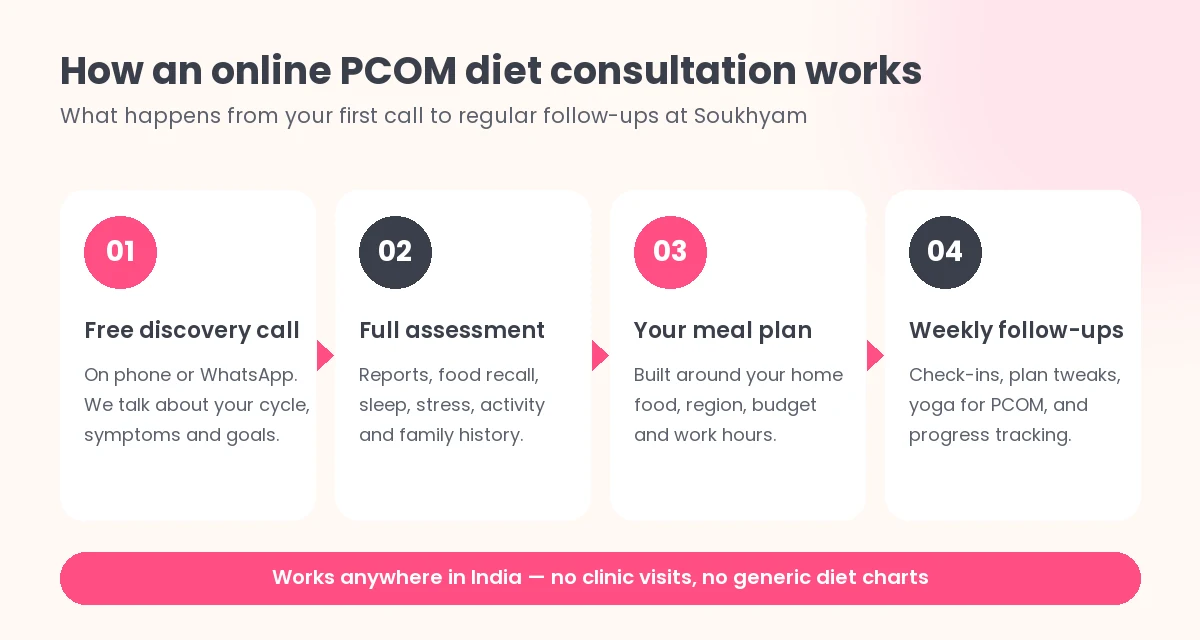
The four stages of an online PCOM diet consultation at Soukhyam.
1. A free discovery call
We talk about what is bothering you most — irregular periods, weight gain around the belly, acne, hair fall, sugar cravings, fatigue or trouble conceiving — and what you have already tried. This is also your chance to ask how the program works and decide whether it suits you. There is no obligation to sign up.
2. A detailed assessment
This is where an online PCOM dietitian earns their fee. Expect questions about far more than food:
- Your cycle history — dates of your last few periods, flow, pain and any diagnosis from your gynaecologist.
- Recent reports, if you have them — for example fasting blood sugar, HbA1c, lipid profile, thyroid (TSH), vitamin D and B12, hormone tests and ultrasound findings.
- A 24-hour food recall — what you actually ate yesterday, including the chai, biscuits and late-night snacks.
- Lifestyle — work hours, sleep, stress, activity, who cooks at home and how many people eat together.
- Medicines and supplements you take, so the plan works with them and not against them.
3. A meal plan built around your food
Your plan should look like your kitchen. If you are from Odisha, it includes pakhala-style meals made PCOM-friendly. If you are South Indian, it works with idli, dosa and sambar. If you are vegetarian, it solves the protein gap without forcing supplements. If you cook for a family, the same base meal works for everyone with small changes on your plate. Plans that ask you to cook separately usually fail by week three.
4. Weekly follow-ups and adjustments
Follow-ups are where results come from. Each check-in reviews what was easy, what was hard and what changed — energy, cravings, sleep, waist measurement, cycle dates and skin. The plan is then adjusted. At Soukhyam we also add yoga and Pilates sessions where helpful, because regular movement improves insulin sensitivity and stress, both of which matter in PCOM.
What does a PCOM-friendly Indian plate look like?
The simplest tool we use is the plate method. It needs no calorie counting and works with any regional cuisine: fill half your plate with non-starchy vegetables, a quarter with protein, and a quarter with whole grains or millets. On top of that, a few principles make the biggest difference for PCOM:
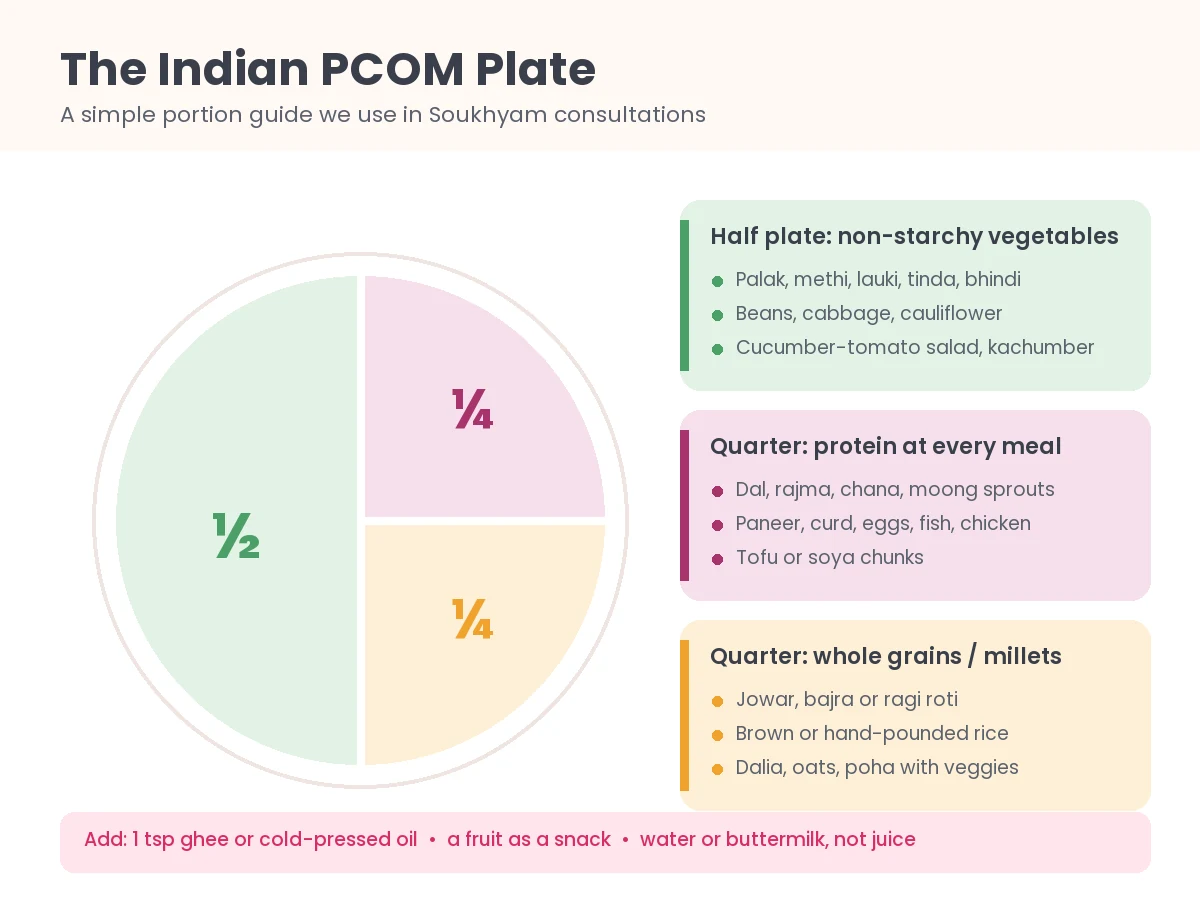
The Indian PCOM plate: half vegetables, a quarter protein, a quarter whole grains or millets.
- Protein at every meal, especially breakfast. Most Indian breakfasts are almost entirely carbohydrate. Adding curd, paneer, eggs, besan or sprouts slows the rise in blood sugar and keeps you full longer.
- Fibre first. Starting a meal with salad or sabzi before the rice or roti can blunt the post-meal glucose spike.
- Include healthy fats. A teaspoon of ghee or cold-pressed mustard, groundnut or sesame oil per meal, plus a small handful of nuts and seeds such as walnuts, almonds, flaxseed, chia or pumpkin seeds, keeps you full and supports hormone production. Fatty fish like rohu, mackerel or sardines add omega-3s for non-vegetarians. Limit vanaspati, reused frying oil and packaged fried snacks, which carry unhealthy trans fats.
- Swap, don’t ban. Rice and roti are not the enemy. Portion size, the type of grain and what you eat alongside them matter more.
- Watch the hidden sugar. Sweetened chai two or three times a day, packaged juices, biscuits and “healthy” granola bars add up quickly.
- Regular meal timing. Long gaps followed by a heavy dinner tend to worsen cravings. Three meals and one or two planned snacks suit most women.
Simple Indian food swaps for PCOM
Common habit
Better swap
Why it helps
Poha or upma alone for breakfast
Vegetable poha with peanuts + a bowl of curd, or moong chilla
Adds protein and fibre to a mostly-carb meal
Three maida or white-flour rotis
Two jowar, bajra or ragi rotis
More fibre, slower glucose rise
Large plate of white rice with thin dal
Smaller rice portion, thicker dal, sabzi and salad
Same food, better balance on the plate
Sweet chai with biscuits, twice a day
Green tea or ginger tea with roasted chana or a handful of nuts
Cuts hidden sugar and refined flour
Packaged fruit juice
Whole fruit such as guava, apple, orange or pear
Keeps the fibre, avoids a sugar rush
Fried evening namkeen
Sprouts chaat, makhana or buttermilk
Protein and volume with less refined oil
Sample one-day vegetarian Indian meal plan for PCOM
Here is what one day can look like for a vegetarian woman with PCOM and a desk job. It is an example to show the structure, not a prescription — portions and choices change based on your reports, weight goals, activity and preferences.
Time
What to eat
Early morning
Warm water, 5–6 soaked almonds and 1 walnut
Breakfast
2 moong dal chillas with grated vegetables + mint chutney + a small bowl of curd
Mid-morning
1 guava or apple + green tea or ginger tea
Lunch
1–2 jowar or bajra rotis, rajma or chana dal, a seasonal sabzi and buttermilk
Evening
Roasted chana or makhana, or sprouts chaat with lemon
Dinner (by 8 pm)
Paneer or tofu bhurji with vegetables, a small portion of brown rice or 1 roti, and a light soup
Non-vegetarians can rotate eggs, fish or chicken into breakfast, lunch or dinner. If you have diabetes, thyroid disease or take metformin or other medicines, your plan must be adjusted by a professional who has seen your reports.
Yoga and stress management: a holistic approach to PCOM
Food is one pillar of PCOM care. A holistic approach also works on movement, sleep and stress, because all three affect insulin and hormones. This is where yoga fits naturally alongside your meal plan — and why Soukhyam combines nutrition with yoga and Pilates.
Yoga practice for better results
Regular movement improves how your body uses insulin, even without weight loss. The 2023 International Guideline encourages adults with PCOM to aim for at least 150 minutes of moderate activity a week, including muscle-strengthening work on two non-consecutive days. Yoga is an easy way to build that habit, and Indian research supports it: in a randomised trial of adolescent girls with PCOM, a 12-week holistic yoga program improved insulin resistance and cholesterol levels more than conventional exercise. Practices we commonly teach include:
- Surya Namaskar at a slow, steady pace — a full-body warm-up that builds strength and stamina.
- Baddha Konasana and Supta Baddha Konasana (butterfly and reclined butterfly) — gentle hip and pelvic openers.
- Bhujangasana and Dhanurasana (cobra and bow) — back-strengthening poses that also open the abdomen.
- Setu Bandhasana and Malasana (bridge and garland) — strengthen the glutes, legs and pelvic floor.
- Mat Pilates core work — builds the muscle strength the guideline recommends.
Stress management through yogic relaxation
Long-term stress raises cortisol, disturbs sleep and drives sugar cravings — all of which make PCOM symptoms harder to manage. Women with PCOM also have higher rates of anxiety and depression, which the 2023 guideline recommends screening for. Simple yogic relaxation practices calm the nervous system and need only 10–20 minutes a day:
- Nadi Shodhana (alternate-nostril breathing) — 5 minutes in the morning or after work.
- Bhramari (humming-bee breath) — 5–7 rounds to settle a racing mind.
- Yoga Nidra — a 15–20 minute guided relaxation before bed to improve sleep.
- Shavasana — at least 5 minutes at the end of every yoga session.
- A sleep routine — screens off 30 minutes before bed and 7–8 hours of sleep most nights.
These practices support, but do not replace, treatment for anxiety or depression. If low mood or anxiety persists, please speak to your doctor.
Online vs in-clinic dietitian for PCOM: which is better?
For PCOM nutrition, online care is not a compromise. Diet counselling relies on conversation, reports and regular follow-up — all of which work well remotely. Here is how the two compare:
Factor
Online consultation
In-clinic visit
Access
From any city or town in India, or abroad
Limited to dietitians near you
Follow-up frequency
Easy weekly check-ins, plus WhatsApp for quick doubts
Usually every 2–4 weeks because of travel time
Real-life feedback
Share meal photos and see your own kitchen in context
Based on what you remember at the appointment
Time and cost
No travel or waiting room; fits around work
Travel time plus a half-day off for many women
Physical tests
Blood tests and scans done at a local lab; reports shared online
Body-composition scans may be available on site
The one thing online consultation cannot replace is a medical examination. If you have not yet been diagnosed, see a gynaecologist or endocrinologist first — then bring those findings to your dietitian.
How to choose an online PCOM dietitian in India
Anyone can call themselves a “nutritionist” on social media. Before you pay, check for the green flags and walk away from the red ones.
Green flags
- Clearly stated qualifications in dietetics or nutrition
- Asks for your reports, medicines and cycle history before planning
- Uses your regional, everyday food
- Talks about realistic, gradual change
- Encourages you to stay in touch with your doctor
- Offers scheduled follow-ups, not just a PDF
Red flags
- Promises to “cure” or “reverse” PCOM permanently
- Very low-calorie diets, juice cleanses or detox teas
- Bans whole food groups for everyone (all grains, all dairy)
- Pushes expensive supplements as part of every plan
- Tells you to stop prescribed medicines
- Guarantees a fixed kilo loss in a fixed number of days
What results can you expect, and how soon?
Every body responds differently, and PCOM changes slowly. Rather than a promise, here is the general pattern we see and what the research supports:
- First 2–4 weeks: steadier energy, fewer sugar cravings and less bloating are often the first changes women notice once meals are balanced and regular.
- Around 3 months: this is a sensible point to review cycle regularity, waist measurement and weight trend, and to repeat blood tests if your doctor advises it. Ovarian follicles take roughly this long to mature, so cycle changes need patience.
- 6 months and beyond: skin and hair changes are the slowest. Long-term habits are what keep insulin resistance in check.
Track more than the scale. Cycle dates, waist size, energy, sleep, mood and skin tell a fuller story — and the 2023 guideline notes that healthy lifestyle changes bring benefits for women with PCOM even without weight loss.
When should you see a doctor instead of (or as well as) a dietitian?
A dietitian helps you manage PCOM through food and lifestyle; diagnosis and medicines come from your doctor. Please see a gynaecologist or endocrinologist promptly if you have:
- No period for three months or more (and you are not pregnant)
- Very heavy or prolonged bleeding
- Rapid new hair growth, a deepening voice or other sudden changes
- Excessive thirst, frequent urination or unexplained weight loss
- Been trying to conceive for 12 months (6 months if you are over 35)
- Persistent low mood or anxiety — these are more common with PCOM, and help is available
How Soukhyam’s online PCOM nutrition program works
Soukhyam is the wellness practice of Sanjibeeta Moharana, a Holistic Dietician (DDHN, HDM), RYT 500 certified yoga teacher and Mat Pilates instructor with more than five years of experience coaching women online. Her holistic approach to PCOM combines three things that usually sit in separate clinics:
- Personalised Indian nutrition — meal plans built from your home food, region and routine, revised at every follow-up.
- Movement that suits PCOM — yoga and Pilates sessions focused on strength, insulin sensitivity and stress, not punishing workouts.
- Accountability — regular check-ins on WhatsApp and video so you are never left alone with a PDF.
Sanjibeeta’s own 53 kg weight-loss over five years, achieved through mindful eating, yoga and lifestyle change, shaped how she coaches: slow, sustainable and without extremes. You can read more about her programs on the Services page or join an upcoming workshop.
Book a free PCOM diet consultation
Tell us what you are dealing with — irregular cycles, weight, acne, cravings or fertility plans — and we will explain how a personalised plan would work for you. Online, anywhere in India.
Frequently asked questions about online PCOM diet consultations
Can PCOM be cured with diet?
No. PCOM is a long-term condition that cannot be permanently cured, by diet or by medicine. But it can be managed very well. A balanced diet, regular activity, good sleep and stress management can improve insulin resistance, cycle regularity, weight, skin and energy, and lower the long-term risk of type 2 diabetes. Be cautious of anyone who promises a cure.
Is an online dietitian consultation as effective as meeting in person for PCOM?
For most women, yes. PCOM nutrition care depends on a detailed history, your blood reports, a realistic meal plan and consistent follow-up — all of which work well over video, phone and WhatsApp. Online care often makes weekly follow-ups easier, which is where most progress happens. You will still need a doctor for diagnosis, examinations and prescriptions.
Do I have to stop eating rice and roti if I have PCOM?
No. You do not need to give up rice or roti. What helps is changing the portion, choosing whole grains or millets such as jowar, bajra and ragi more often, and pairing grains with protein and vegetables. The 2023 International Guideline does not recommend cutting out any food group for everyone with PCOM.
I am thin but have PCOM. Do I still need a dietitian?
Yes. Lean women can have PCOM and can still have insulin resistance, irregular cycles, acne or low energy. For them the goal is not weight loss but better meal balance, enough protein, steady blood sugar, strength training and good sleep. South Asian women can develop insulin resistance at a lower body weight, so a “normal” BMI does not rule it out.
Should I take inositol or other supplements for PCOM?
Possibly, but only after discussing it with your doctor. The 2023 guideline says inositol may be considered based on personal preference, has limited side effects, and shows some benefit for metabolic markers, but evidence for improving ovulation, weight or hair growth is limited. Vitamin D or B12 may be needed if your tests show a deficiency. Supplements support a good diet; they do not replace it.
How long does it take for periods to become regular with a PCOM diet?
It varies. Some women notice cycle changes within two to three months of consistent eating and activity changes, while others need longer or need medical treatment as well. A three-month review is a sensible checkpoint. If you have had no period for three months or more, see your gynaecologist rather than waiting.
Which reports should I share before my online PCOM consultation?
Share whatever recent reports you have; you do not need to get new tests just for the consultation. Useful ones include fasting blood sugar, HbA1c, lipid profile, thyroid (TSH), vitamin D and B12, any hormone tests your doctor ordered, and your pelvic ultrasound report. Also note your last few period dates and any medicines or supplements you take.

ABOUT THE AUTHOR
Sanjibeeta Moharana
Holistic Dietician (DDHN, HDM), RYT 500 certified yoga teacher, Mat Pilates instructor and face yoga expert. Founder of Soukhyam, she has spent more than five years helping women across India build sustainable eating and movement habits through online coaching.